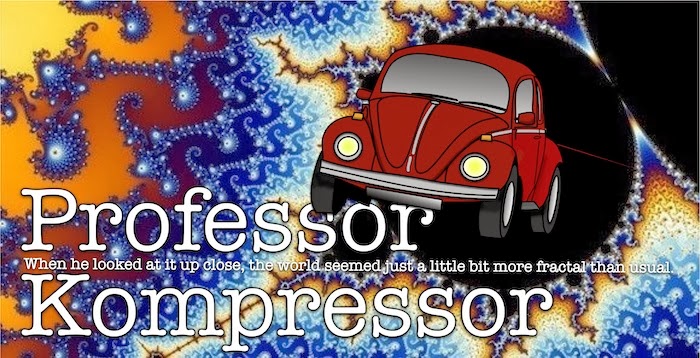
The rain was bucketing down.
It was just a couple of weeks before Christmas and the climate had gone mad.
Professor Kompressor had heard about global warming, but he did not use to
think much of the idea. This so-called winter was making him reconsider. Then,
all of a sudden, the weather changed. From madness to normality in an instant.
The temperature dropped and several inches of snow fell. Children had to stay
at home because the schools were closed. The Professor had to dig out his warm
winter clothes. He also had to dig himself out of the house each morning, just
to pick up the post.
The Professor enjoyed winter,
but he was not keen on Christmas. He could not see the point of all the glitzy
decorations and the shiny lights. To bring an entire tree inside... for
goodness sake! Being a practical man, he obviously did not believe in Father
Christmas either. He probably had done when he was a little boy, but he
suspected that he had been tricked by his parents. He did not like the thought
of that. A man with a white beard, in a factory at the North Pole making toys,
and then distributing them one particular night of the year. To all the children
in the world. Ridiculous idea. Absolutely ridiculous.
It was Christmas Eve. The Pig-Dog
was sleeping on a cushion by the open fire in the sitting room. His legs were
twitching as if he were chasing something in his dreams, perhaps a rabbit. He
was snoring.
The Professor was sitting in
his favourite chair reading a book about the famous inventor Leonardo da Vinci.
There were some very interesting sketches in the book, and he was trying to
figure out how these machines were supposed to work.
They had had a nice meal.
Possibly on the modest side given the season, but still nice. Now they were
settling in for the evening.
It was getting dark outside.
It was cold and the skies were clear. A perfect night for stargazing.
Suddenly, they were startled
by a loud crash from upstairs.
It sounded as if a large
cupboard had fallen over.
Then came a drawn out screech.
Something heavy slid down the roof. Loose tiles clattered to the ground.
A second crash. Louder than
the first.
Something had fallen off the
roof and landed, not very gently, in the back garden.
Spot and the Professor,
already on their feet, rushed to see what was going on.
When Professor Kompressor
opened the patio doors, he was faced with the most amazing scene.
Chaos reigned in the back
garden.
Several large animals with
what seemed to be horns on their heads limped around over by the gooseberry
bushes.
A large sleigh-like object had
crash-landed in the middle of the lawn.
A round man with a grey beard
and a red woolly hat was standing by the sleigh mumbling to himself.
“Oh-oh-oh,” he said. “What
have we done?”
“Oh, Rudolf, I think we’re
done for this time...”
The Professor surveyed the
scene of the apparent accident. He was too stunned to think clearly. Yet
something tickled his memories.
Surely, it could not be. Could
it?
Spot had no such reservations.
He dashed into the garden, barked happily at the reindeer and jumped up to
greet the bearded man.
“Good evening, Spot,” cheered
the man.
“Who’s a good little doggie,
then?”
“Have you deserved your
Christmas bone? Have you?”
The man scratched Spot behind
the left ear. The dog really liked that.
Professor Kompressor finally
regained his senses.
“Hmm. Excuse me, but... are
you... can’t be...”
The words stumbled out of his
mouth.
“Afraid so,” said the man. “This
old sleigh is going nowhere tonight.”
“The children will be so
disappointed.”
“Dreadful,” he added, even
though there was no need for it.
Father Christmas turned to
Professor Kompressor.
“Do you think?” he started.
“Do you think you could help?”
“Can you fix it?”
It only took the Professor a
moment to decide that the answer was a definite no. The sleigh was not going
anywhere that night. It was too badly damaged. Besides, the poor reindeer
looked dazed and confused. Some of them were limping badly. They needed a rest.
The situation could not have been worse.
The Professor’s brain was
working hard. There had to be a way out of this jam. He could not let the
children down. He had to fix this.
But what could he possibly do?
The crashed sleigh seemed a non-starter, and they were running out of time.
There was no time for
thinking. They needed action. Immediately.
Professor Kompressor was not
used to inventing under time pressure. He was not good at dealing with
stressful situations. He needed to be in a relaxed frame of mind for the ideas
to flow, and he knew that inventions needed to be tested properly. Otherwise
they could be quite dangerous. He had learned this the hard way.
There was no time for caution.
He had to make quick decisions, and whatever he came up with had to work.
It just had to.
The Professor realized that he
would not be able to create something new. He had to recycle.
He had a shedful of discarded
inventions. The problem was that they had not worked in the first place. Was
there some way that he could cobble something together out of bits and pieces
from the shed?
He decided to give it a go.
The obvious starting point was
the flying car. How badly damaged was it? It should have dried out by now, but
would the engine work? Could it still fly? And what about the power source? It
was night, so solar power was out of the question. Was there a way to replace
it? Would batteries work? They only had to last one night. After that it did
not matter if they were out of juice.
“It can be done!” said the Professor.
“But we’ll have to take some risks.”
“Risks?” laughed Father
Christmas. “Dear Professor. I’m rather familiar with risks. It’s not as if it’s
safe to fly about in a sleigh pulled by reindeer. Bad enough in daylight, but
during the night...”
“I think this evening’s
experience says it all.”
They moved over to the shed
and dragged the wrecked car into the snowy garden.
It looked a little bit worse
for wear, but the damage was mostly cosmetic.
The Professor went into the
house, and searched the inventing studio for the extra powerful battery cells
that he had been working on. To his great relief, they were fully charged. He
picked them up along with some tools and went back outside.
He was concentrating so hard
that he did not notice that he was still in his slippers, and it was freezing
cold.
Father Christmas watched with a
mixture of amazement and amusement as the Professor ripped out parts of the car’s
engine and threw them in the snow. There was not much he could do. He was not exactly
good with mechanical devices. The Professor, however, was excellent at
inventing things. And this time the invention would have to be excellent. There
were no alternatives.
Professor Kompressor wired up
the batteries and jumped into the driver’s seat.
When he flicked the switch the
car’s engine made a noise... and then... nothing.
It did not work.
What was wrong? The Professor
tried to think it through, but it was hard to concentrate. There was too much
pressure.
He opened the bonnet and
glared down at the engine. The construction was a complete mess. He had been
tearing bits out and adding new parts, mostly using gaffer tape and bits of
string. The end result was a virtual bird’s nest of wires, tape and string.
How could he possibly get this
to work?
Then it struck him! Reverse
double wiring! He had wired the batteries as he would for a normal engine, but
this invention was far from normal. Maybe he just had to reverse it?
He dived in, tore off some
wires and reattached others.
Back in the driving seat, the
Professor tried the switch again. This time the car jumped to life, literally.
It lifted off the snow-covered ground and the headlights came on.
Two bright beacons of light
lit up the field.
“Get the presents in! Quick!”
the Professor called out.
He did not have to say this
twice. Father Christmas was already on his way, carrying a massive sack full of
presents for children all over the world. He opened the passenger side door and
tried to push the sack into the backseat. It was far too big. There was no way
that it would fit.
Of course, the sack had been
too big for the sleigh as well. It took a whiff of magic to make room for it.
They were ready to go.
“You’d better drive,
Professor,” said Father Christmas. “I’ll handle the deliveries.”
Off they went, zooming over
the starlit landscape.
In no time at all, they
delivered presents to the houses in the village.
They carried on, making
deliveries all over the country.
It was done at incredible
speed. They hardly came to a stop at each individual house. Father Christmas
was down the chimney and up again in not time at all. Soon the journey turned
into a bit of a blur and Professor Kompressor had no idea where they were or
where they had been. They pushed on regardless.
They flew over mountain ranges
covered with snow, African plains on the edge of the desert, and exotic islands
with palm trees.
It was an amazing trip, but
they did not have time to stop to enjoy the scenery.
Dawn was approaching. They
still had an entire continent to go. Professor Kompressor pushed the accelerator
all the way to the floor. The flying car responded and, even though it seemed
impossible, went even faster.
Finally, Father Christmas
climbed back into the passenger seat, looked in the back and said, “That’s the
last one. We did it!”
“Let’s go back home.”
They returned to Professor
Kompressor’s house at a more sedate pace, landed by the garden shed and stepped
out in the snow. The sun was rising in the east. It was going to be another
crispy cold, clear day.
The Professor woke up in the
sitting room chair. It was morning. He had had the weirdest dream about helping
Father Christmas. Completely bonkers.
He walked over to the window
and looked out into the back garden. Fresh snow had fallen. There were
certainly no traces of a crashed sleigh.
It was a beautiful morning.
Then he noticed it.
Something was not quite right.
The door to the garden shed
had been left ajar. The flying car, covered by a thin layer of snow, was parked
outside.
“Surely not?” thought the
Professor.
He went into the kitchen to
make some tea. He clearly had not woken up properly yet.
On the kitchen table sat a
nicely wrapped present and a note.
“Dear Professor,” it
said.
“Thank you so much for
saving Christmas. I don’t know what I would have done without your help. Keep
up the good inventing work.
PS
Maybe I’ll
see you again next year.”
F.C.